

A Beauty Historian Sets the Record Straight
Jewish American Heritage Month, the real history of lipstick, and the OG Jews of the beauty industry

Hello, Gorgeous!
If you’ve read my first book Hello Gorgeous! Beauty Products in America ‘40s'-‘60s (A New York Public Library book of the year/Book for the Teen Age; I promise a reissue is coming sooner rather than later), you’ll know that I paid homage to some of the Jewish OGs who created the beauty industry as we know it. I say it not to brag about my people, but because May is Jewish American Heritage Month and perhaps reminding beauty people about the origins of their favorite brands may help them remember just how much members of the tribe contributed to the beauty industry.
But first, let’s debunk a common internet rumor about the history of the lipstick tube.
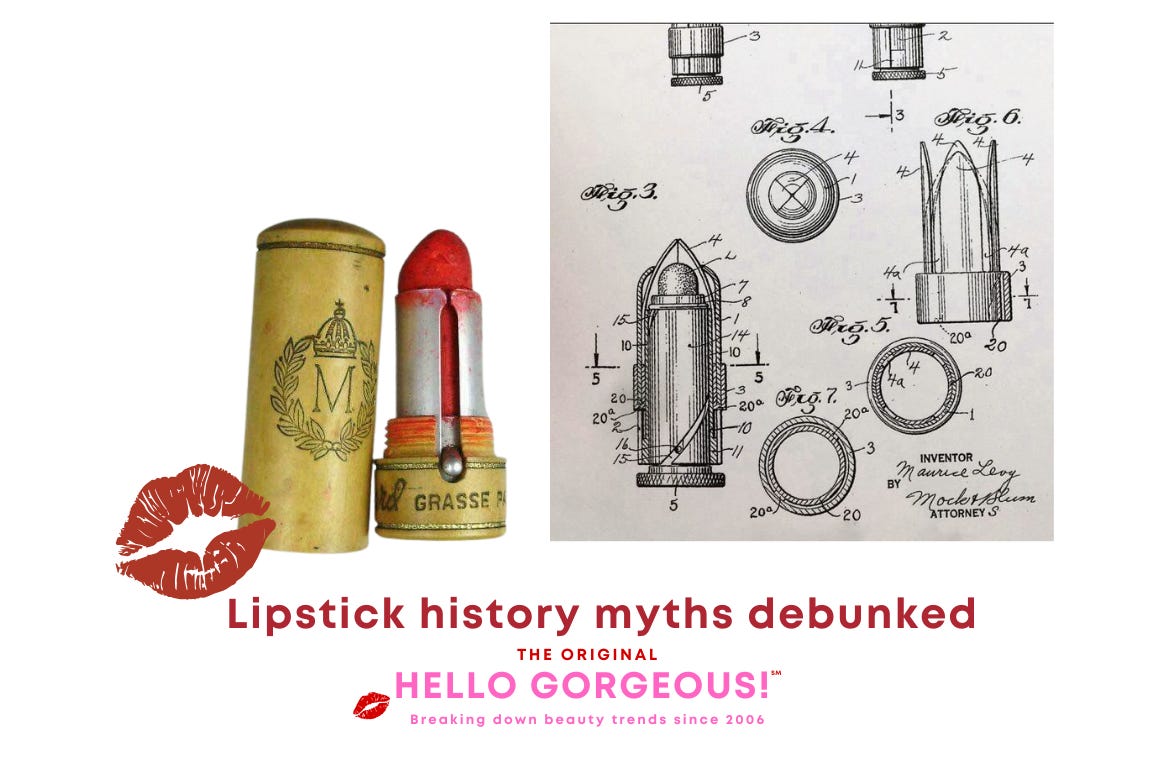
Did a Jewish inventor create the modern lipstick tube?
Sort of.
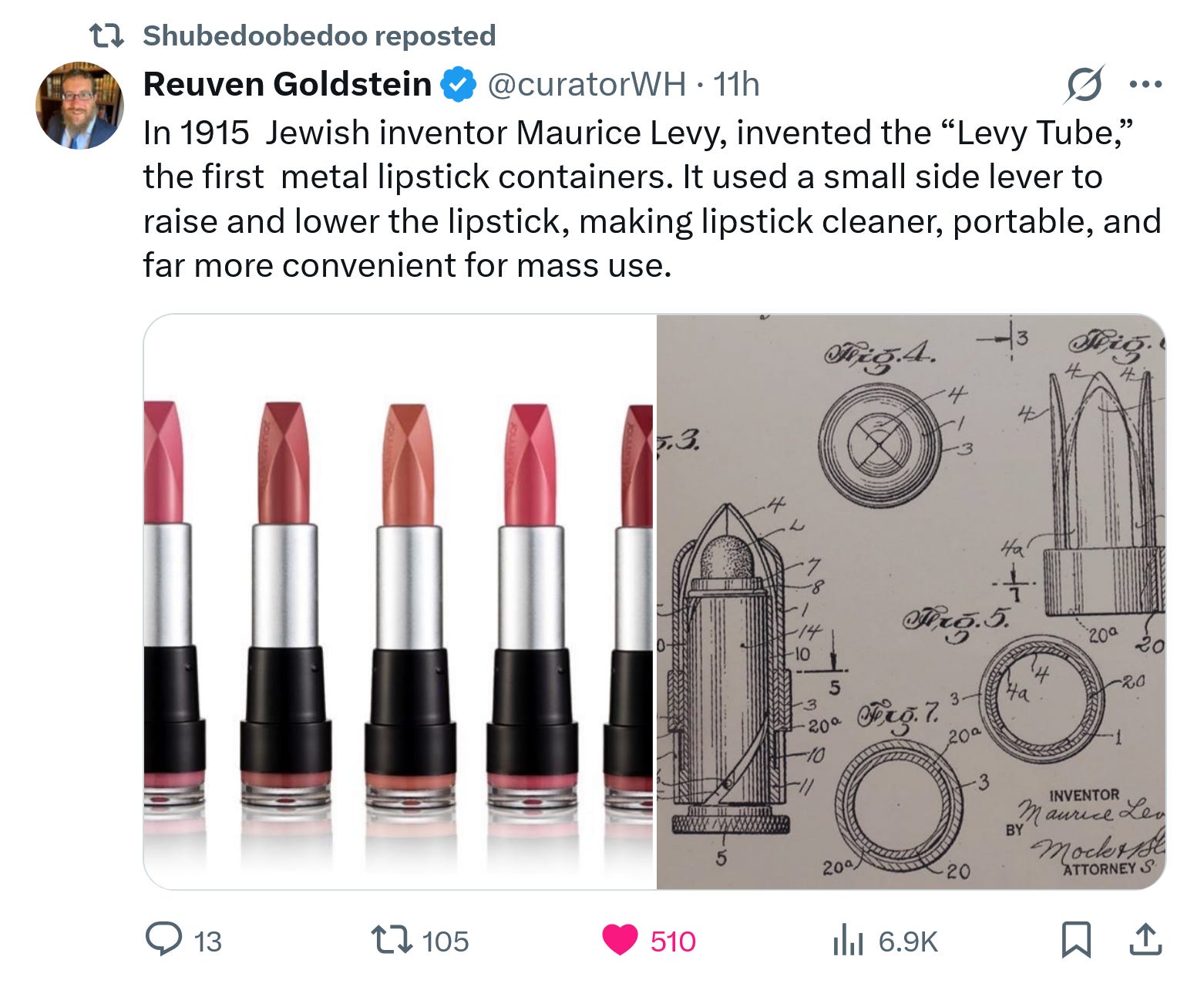
A popular tweet declares that Jewish inventor Maurice Levy invented the modern lipstick tube. The truth is that the lipstick tube wasn't invented by one person on one date. It evolved across 1,000+ years, multiple countries, and a tangle of competing patents. The viral version is a lovely story. It just isn't quite the whole story (I’m happy to talk ancient Mesopotamian lip sticks with anyone as obsessed with beauty history as I am!).
Did Elizabeth Arden hand out tubes of red lipstick to suffragettes marching down Fifth Avenue?
No. She did not.
Another hugely popular urban beauty legend is that Elizabeth Arden née Florence Nightingale Graham handed out tubes of red lipstick (often called "Red Door Red") to suffragettes marching down Fifth Avenue on May 4, 1912, as a symbol of solidarity. It's the kind of story that should be true — woman business owner, women's rights, red lips as rebellion. I've received many press releases from the Elizabeth Arden brand making that easily debunked claim over the years, including in their 2018 March On campaign with Reese Witherspoon. The problem? There's no evidence it actually happened. Historian Lucy Jane Santos went through the extensive New York Times coverage of the meticulously-planned 1912 march — every detail of what the women wore was reported, right down to the 30-cent white straw "suffragette hats" — and nobody mentioned lipstick. What Florence Graham did do that day was march in the rally herself. The lipstick handout was embroidered in later, by the brand, which feels like bad business. If you’re sharing false facts about the history of the brand, it could cause consumers to question product claims.
Now that we've cleared the (lipstick-smudged) air, let's talk about the real mensches of the Jewish American beauty industry.
Helena Rubinstein, born Chaja Rubinstein in Kraków in 1872 to an Orthodox Jewish family, fled an arranged marriage at 18, ended up in Australia with twelve pots of her mother’s face cream in her luggage, and from that built the world’s first global beauty empire. By the time she died in 1965, she’d done it all — Paris, London, New York — and famously bought an entire Park Avenue building after being denied an apartment for being Jewish. Her motto: “Beauty is power.”
Max Factor, born Maksymilian Faktorowicz in 1872 in Zduńska Wola, Poland, into a poor Polish-Jewish family. He fled Tsarist anti-Jewish persecution in 1904, landed in Hollywood, and invented the entire visual language of movie-star beauty. Jean Harlow’s platinum hair? Him. Clara Bow’s heart-shaped lips? Him. Joan Crawford’s overdrawn lip? Him. He also coined the word “make-up” as a noun, in 1920.
Estée Lauder, born Josephine Esther Mentzer in Corona, Queens, in 1908, to Hungarian and Czech Jewish immigrants. Learned to make face cream from her chemist uncle John Schotz in his home laboratory. Launched Estée Lauder Cosmetics out of a former restaurant kitchen in 1946. Invented the “Gift with Purchase.” Today the Estée Lauder Companies own Clinique, MAC, La Mer, Aveda, Jo Malone, Too Faced — and yes, Bobbi Brown.
Charles Revson, born Charles Haskell Revson in 1906 in Somerville, Massachusetts, to Lithuanian and German Jewish immigrant parents. Started Revlon in 1932 with his brother Joseph and chemist Charles Lachman (that’s the “L” in Revlon) — $300 and a single product: a brand-new opaque, pigmented nail enamel. He invented matching lips and fingertips in 1939, and one of the most-quoted lines in the history of marketing: “In the factory we make cosmetics; in the store we sell hope.”
Bobbi Brown, born Bobbi Brown (yes, really Bobbi — not a nickname) in 1957 in Chicago to a Jewish family. Frustrated by the over-the-top 1980s palette, she partnered with a chemist to create ten natural-shade lipsticks, launched them at Bergdorf Goodman in 1991, and changed the way women wore makeup. Sold to Estée Lauder in 1995. Now running Jones Road. She’s also been openly Jewish about it, including a 2022 TikTok moment when she told her followers not to contour their “Jewish noses.”
Vidal Sassoon, born in 1928 in London to Sephardi and Ashkenazi Jewish parents. His father walked out when he was three; his mother placed him in a Jewish orphanage where he stayed for seven years. He left school at 14, apprenticed as a hairdresser, and at 17 joined the 43 Group — a militant Jewish veterans' organization that physically broke up Oswald Mosley's post-war fascist rallies in East London. In 1948 he went to Israel and fought in the War of Independence. Then he came home and changed hair forever — the five-point cut, the wash-and-wear bob, the geometric architecture that freed women from the curler-and-hairspray tyranny of the 1950s. He later founded the Vidal Sassoon International Center for the Study of Antisemitism at Hebrew University. The man who said "if you don't look good, we don't look good" knew exactly what hatred looked like.
Beauty friends and fans, you know I never get political here and try to only mention joyous topics, but sometimes I have to speak up. Things are heating up in the world and Jews are on the receiving end of a lot of hatred and attacks. If you think you've never met anyone Jewish before, think again. You may have just powdered your nose, lined your lips, styled your hair with products invented by, or read beauty content written by a proud Jew.
Do you have any beauty myths you’d love debunked? Let’s meet in the comments to discuss!
Rachel, Your beauty concierge 💋
Quick note: I included some affiliate links and from time to time some sponsored products which means I might earn a small commission on sales made through these links, but I also throw in stuff I love just because. Prices are current at publish time.
Great article, as always. If I may, I would love to acknowledge salon owners, the late Arnold and Sydell Miller, who founded Matrix right here in Cleveland (Solon aka Salon), Ohio! This was one of the first privately owned salon brands to reach $300 million in sales with brands like Matrix, Biology and Vavoom!, as well as perms and hair color used in salons. Arnie, a hairdresser, championed his colleagues, giving hairstylists a new sense of pride—and income. Sydell created the concept called Total Image Consulting, which gave salons the products, services, systems and education to provide clients with beauty and wellness from head to toe. I was proud to work with them for six years. Then, Arnie passed and the company was sold to first Bristol-Myers Squibb and then to L'Oréal, who still owns it today. The Millers' passion truly changed the salon industry forever!
Wow - so much of this I didn't know! Thank you for sharing Rachel xo