

Reading Labels Like Your Health Depends on It
Beyond Beauty part one: Why I'm obsessed with ingredients

Hello, Gorgeous!
Years back I dated a guy who loved Diet Coke. He loved me more, so he stopped drinking it. Why, you may ask? Because I have a whole lot of ingredient sensitivities and if he drank some Diet Coke and then kissed me, I might have ended up really ill.
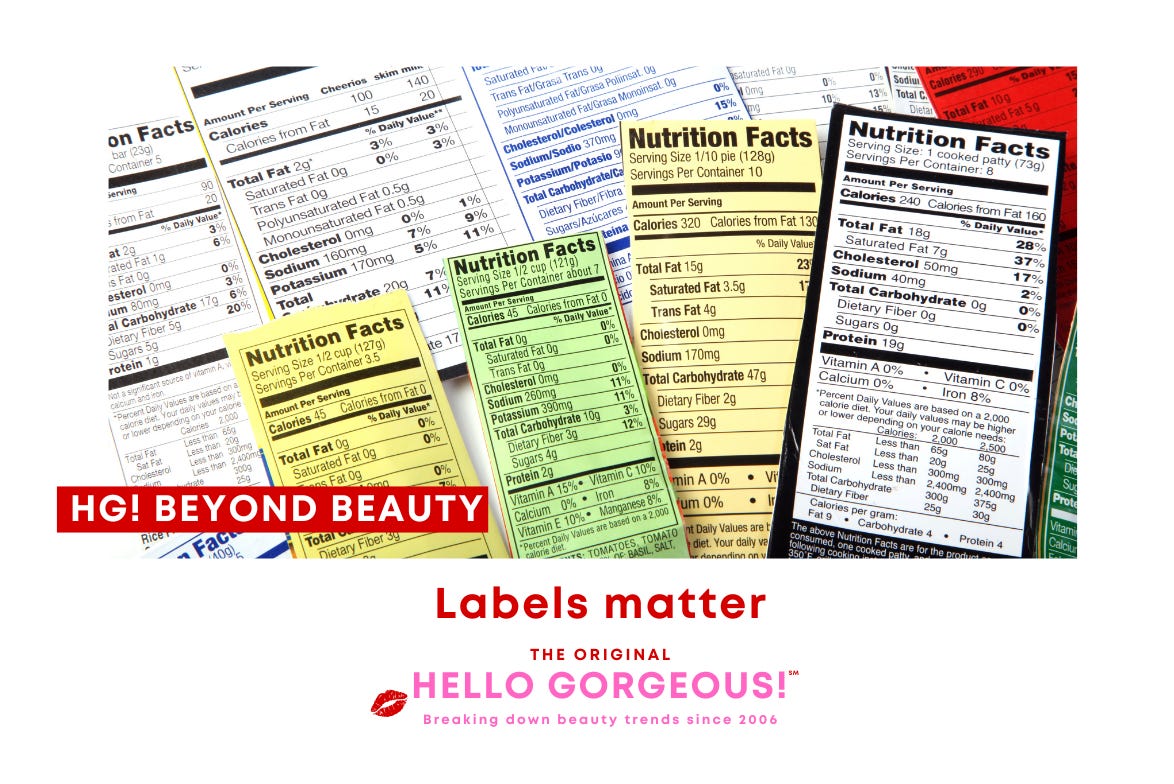
I say this as someone so sensitive to some ingredients that if a person opens a packet of Sweet’ N Low near me, I taste the particles in the air (true story). And for years, even that tiny amount of exposure made me sick. More digestive weirdness: I can’t eat apples with the peels on. And before you say “but that’s natural” — yes, exactly. Which is the whole point. Natural is not a safety guarantee. It’s not even a useful category when your body has its own opinions. Apple peels are about as natural as it gets, and they’re a problem for me because of cellulose — a fiber that, like the outer hull of corn, the human body simply cannot break down. It passes through. For some of us, that process is not pleasant.
So when I tell you I read labels obsessively, understand that for me it has never been abstract. It has been, at various points, the difference between a normal afternoon and a genuinely terrible one, followed by days in bed.
Here’s part two in the series

I’ve spent decades reading labels. Not as a nutritionist — I am emphatically not one, nor do I play one on the internet — but as someone who has spent decades studying the way my body reacts to food and complicated ingredients. At this point I’m pretty much constitutionally incapable of putting something in or on my body without wanting to know exactly what it is, what it’s made of, and what it’s supposed to do. Or to at least try to understand why it might be bad for me…or you.
If you’ve been reading Hello Gorgeous! for a while, you know I do this with skincare: I break down actives, flag the ingredients that actually do something vs the ones that are just trending or along for the ride. A few of you have been asking me to apply the same lens to food. So here we are.
The specific territory we’re covering this time around: sugar substitutes and the category of ingredients that have quietly colonized the healthy food aisle. The ones with good PR and complicated relationships with our bodies. This is Part One — the why. Next time, we’ll get into the what: the specific ingredients, what the research actually says, and how to read a label like you mean it.
Why your so-called clean snack makes you feel awful
The cruelest trick of the modern food landscape is that the ingredients most likely to cause problems are clustered in products marketed as good for you. Protein bars. Sugar-free yogurt alternatives. Plant-based everything. Zero sugar beverages. These are the items we reach for when we’re trying to make better choices — and sometimes they are fine. But for a significant and growing number of people, particularly women in perimenopause and beyond, they are absolutely not fine.
Eat up, but pay attention
Here’s something that doesn’t get said enough: what your body tolerated at 30 may hit very differently at 45 or 52. Your hormonal roller coaster might just be hitting reset on your food sensitivities. Something you ate for years without incident may suddenly be a problem. This isn’t in your head. It’s in your hormones.
When tests come back normal
Standard allergy tests didn’t flag any of my sensitivities. Not one. I was tested, told everything came back normal, and continued to feel terrible after eating certain things. It took an endocrinologist to confirm what my body had been telling me for years. I share this not to send you down a diagnostic rabbit hole, but because I know how demoralizing it is to be dismissed. If your tests are “normal” and you still feel bad, you’re not imagining it. You may just need a different kind of doctor asking different kinds of questions. Or become your own best advocate. I’ve spent years being misdiagnosed by multiple doctors across multiple specialties. It was literally my dogged determination that helped me name what does or doesn’t work for me.
And one more thing, because it matters: even the most diligent label reading sometimes isn’t enough. I have gotten violently ill from ingredients I knew were in a dish — ingredients that simply weren’t disclosed. Local restaurants and small food producers don’t always label accurately. Sometimes it’s carelessness. Sometimes it’s that they don’t think it matters. For people like me it really does.
Next up: the specific ingredients to know, what the science actually says about them, and how to read a label the way I’ve been reading them for decades. Bring your reading glasses.
Hello Gorgeous! is for smart women who read everything, including the fine print.
Meanwhile, is this helpful to you? After this two-parter would you be interested in more content like this? Let’s meet in the comments to discuss!
Rachel, Your beauty concierge 💋
Quick note: I included some affiliate links and from time to time some sponsored products which means I might earn a small commission on sales made through these links, but I also throw in stuff I love just because. Prices are current at publish time.
Amen. So glad you're shining a spotlight on these issues! These discussions could help more people look deeper and find solutions to chronic challenges.
Rachel, first I’m so sorry to hear you’ve had such terrible reactions to ingredients for so long. Second, I am absolutely interested in hearing more content in this series - well I’m interested in all your content, but this is of particular interest to me for a couple of reasons. I also have some odd sensitivities, including to some labeled as healthy. Looking forward to hearing more.